A blind dating app where voices matter more than photos
A dating site for blind, low-vision, and monocular daters - and for sighted partners who'd rather get to know a voice than a grid of photos. Profiles can be read aloud, every photo carries an image description, and the whole interface was built with screen readers from day one. You don't have to scroll past a wall of selfies to find a real person here.
Free to join · Voice-first messaging · Screen-reader tested
Why this category exists
Mainstream apps are built around photo grids and rapid swiping - interactions that quietly exclude blind and low-vision daters. Here, voice intros, alt text, and keyboard-first navigation are the defaults, not afterthoughts. Sighted partners who join meet people through stories and tone, the way most relationships used to start.
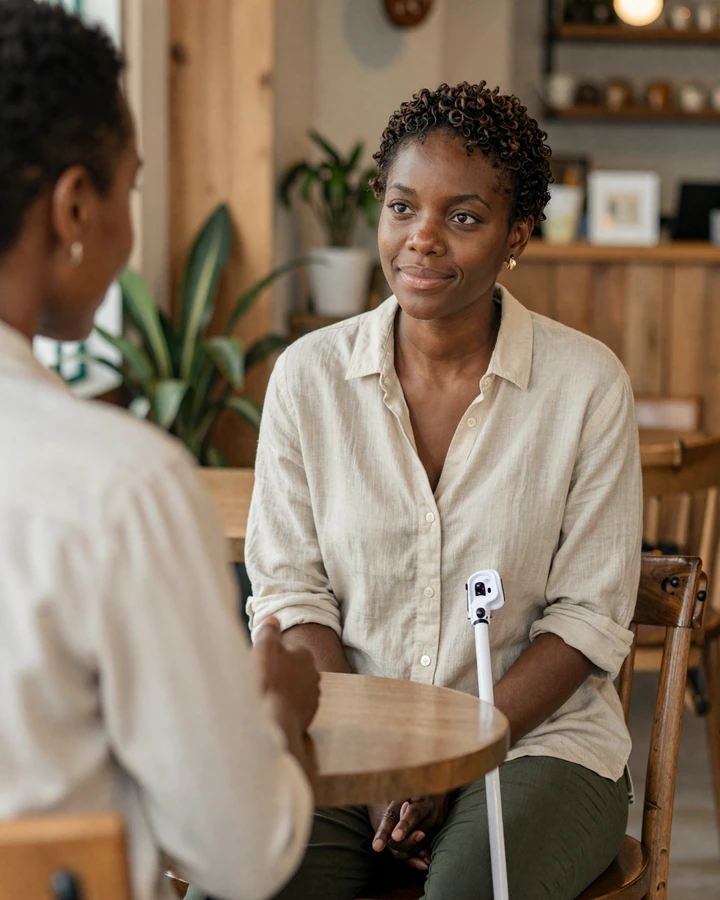
Voice-first communication for blind people dating
Voice-first means the platform doesn't make you do extra work to compensate for a sighted-only design. Three voice features sit at the core of how members meet here, and each one was built specifically to take visual pressure off the dating experience without removing your choice to type or read text whenever you prefer.
Voice profile reading
Every profile can be read aloud with a single keystroke or screen tap, in your screen reader's voice or ours. You listen instead of visually scanning - the same way you'd listen to a podcast intro before deciding whether to keep going. No scrolling fatigue, no photo grid pressure.
Voice introductions
Members can record a short voice intro - 30 to 60 seconds in your own tone, accent, and energy. Voices carry warmth, humor, and pacing in ways no curated photo can. Sighted members report this is often the moment they actually feel they've met someone.
Voice messages
Send and receive voice messages alongside text, for the days when typing or reading feels tiring. Useful for blind daters managing screen-reader fatigue, low-vision daters resting their eyes, and anyone who's just better at talking than typing. Auto-transcripts appear underneath.
Screen-reader compatibility built in, not bolted on
Most dating apps add screen-reader support after a complaint. This one was built with WCAG 2.2 in mind from the first prototype, tested with NVDA, JAWS, VoiceOver, and TalkBack on real screens by real members of the community. That's the difference between an app you can technically use and one you actually want to.
- Full keyboard navigation - no mouse-only menus, no trapped focus, visible focus rings throughout.
- Logical tab order across hero, profile, messaging, and settings - no surprise jumps.
- Semantic HTML landmarks (header, nav, main, aside) so screen readers can skip cleanly.
- ARIA labels on every interactive control - buttons announce what they do, not just "button".
- Form inputs paired with proper labels, error messages spoken on submit.
- Image alt text required at upload - no silent photos in the feed.
- Reduced-motion support honors your OS preference automatically.
- High-contrast mode and resizable text up to 200% without breaking layout.
What members tell us
"I can find the chat tab with two keystrokes. The compose box reads 'Message Daniel - text or voice'. The send button says 'Send message'. None of that sounds revolutionary, and yet I've been on dating apps for ten years where it doesn't exist."
- Member feedback, JAWS user, 2026
Tested with
Tested by paid members of the blind community, not interns. Bug reports go to a dedicated accessibility queue with a 5-day response target.
Image descriptions on every profile
Photos still exist on this platform - sighted members use them, low-vision members use them, and they're a normal part of how a profile feels. The difference is that every photo carries an image description written by the person who uploaded it. It's a feature mainstream dating apps lack, and it changes the experience entirely for blind daters.
Example profile photo description:
"Me at a friend's wedding last spring. I'm a 34-year-old Black woman with short natural curls, wearing a deep green satin dress and dangly silver earrings. I'm laughing at something off-camera, holding a glass of sparkling water. Sunset light, garden behind me with string lights."
Members add descriptions as they upload - the field sits right next to the photo, with a short prompt: who, what you're wearing, what you're doing, where. It takes about thirty seconds. Screen readers announce the description naturally, and sighted users see it underneath as a caption. Low-vision daters have told us it's the field they read first, even when they can technically see the photo.
Monocular vision and partial sight included
Vision isn't a binary. People with monocular vision (sight in one eye), low vision, legal blindness, light perception only, and progressive conditions like retinitis pigmentosa all live somewhere on a long spectrum - and most of them have been told at some point that they don't belong in either the "fully sighted" or "fully blind" conversation. This community sits with you in the middle.
Monocular daters often describe similar frustrations: assumed to be fully blind by sighted partners, told "you don't look visually impaired" by other community members, and asked invasive questions about depth perception on first dates. Members with low vision report the same in-between treatment - too sighted for some spaces, not sighted enough for others. Communication-style badges and a free-text vision section let members describe their experience in their own words rather than picking a label that doesn't fit.
If you're newly adjusting to vision loss, you're also welcome here. Identity takes time, and dating doesn't pause politely while you figure it out. You can start with a low-vision label and update it later, or skip the label entirely.
Disclosure timing when dating a blind person
Deciding when to mention being blind, low-vision, or monocular is personal - there's no correct timeline. Some members put it in the first line of their bio. Others wait until trust develops. Both are valid. Here are the four moments where members typically make a call, and what tends to work at each one.
-
In the profile
Visible from the start. "Blind, voice-first messaging please" or "low vision, partial sight in my left eye" filters out anyone who'd be a problem and saves you the conversation later. Members who do this report fewer matches but better ones - and that math is usually the right trade.
-
Early in chat
A few messages in, when you're past hello but before any meaningful investment. "By the way, I'm blind - I use a screen reader and prefer voice messages, just so you know how I'll be communicating." This works if you'd rather see how someone responds before committing your bio space.
-
Before the first date
If you've waited this long, the first date itself is the deadline - venue choice, transport, whether you'll have a guide dog, and how you'll find each other all become practical. A short message the day before is usually enough: "quick heads-up before tomorrow, I'm visually impaired, here's what's helpful."
-
When trust is real
Some members - especially those with progressive conditions, recent vision loss, or monocular vision - prefer to wait until the relationship has weight before going into detail. That's not deception, it's pacing. The right partner will treat the deeper conversation as intimacy, not a delayed disclosure.
For a fuller framework - including sample language and what a healthy response sounds like - read our disability disclosure guide.
Blind people dating: member experiences
Paraphrased from member messages, lightly edited and shared with permission. Names and small details changed to protect privacy.
On other apps I'd match with someone, ask them to describe their photo, and never hear back. Here the descriptions are already there. I read three profiles in five minutes instead of three hours, and the first guy I voice-messaged became my partner. We met at a tactile-map market - joked we'd followed the maps straight to each other.
Monocular since a car accident at 19. I spent a decade explaining to dates that yes I drive, no I'm not 'totally blind', and yes the joke about depth perception was already old. On here I wrote one line about it and never had to defend it again. My boyfriend asked good questions and moved on.
Related communication-first communities
If voice-first dating resonates with you, two nearby categories share the same calm tone and communication-first approach - one for Deaf and hard-of-hearing daters, and one for autistic members who prefer direct, literal conversation.
Deaf Community
ASL-friendly profiles, captioned video chat, and Deaf-culture-aware design. A communication-first community where text and visual language carry the conversation.
Communication-firstAutism Dating
Direct-communication-friendly dating for autistic adults. Sensory-aware date ideas, neurodivergent badges, no small-talk pressure - literal language welcome.
NeurodivergentBlind dating app: questions answered
Questions blind, low-vision, and sighted members ask most often before joining. Anything else? See the full FAQ page or read our safety and privacy details.
Is there a dating app designed for blind people?
Yes. Fast Dating Chat is a blind-friendly dating app inside a wider disability community. It supports voice profile reading, voice introductions, voice messages, screen-reader navigation tested with NVDA and JAWS and VoiceOver, and image descriptions on every profile photo. Blind, low-vision, monocular, and sighted members are all welcome.
How does dating a blind person actually work on this app?
The same as any other dating: profiles, messages, voice notes, eventually a first date. The differences are practical - voice messages are a normal option rather than a hidden feature, image descriptions sit underneath every photo, and keyboard navigation works everywhere. Sighted partners do not need to learn anything new; the platform handles the accessibility layer.
Do I have to use voice features?
No. Voice features are options, not requirements. Many low-vision and sighted members type and read text exclusively. The platform is built so that any combination - voice-only, text-only, or mixed - works smoothly. Communication-style badges let your match know your preference before the first message.
I have monocular vision. Do I belong here?
Yes. Monocular daters often feel caught between fully-sighted and fully-blind communities, with neither one fitting. This category explicitly includes monocular and partial-sight members. You can describe your vision in your own words - there is no checkbox forcing you to pick a label that does not fit.
When should I disclose being blind on a dating app?
Whenever feels right. Some members put it in their bio; others wait until early chat, before a first date, or until real trust has formed. There is no correct timeline. The community here is built so that disclosure feels like a choice rather than an obligation, and a healthy match will treat it that way too.
Are sighted partners welcome?
Yes - sighted members who want to meet blind, low-vision, or monocular partners are part of this community. The expectation is curiosity over pity, normal conversation over invasive medical questions, and willingness to use the accessibility features built into the app. No fetishization of blindness - that violates the community guidelines.
Is the blind dating app free?
Yes. Profile creation, voice messages, voice intros, screen-reader features, image-description uploads, and full messaging are free permanently. Premium features exist but accessibility is never paywalled - that would defeat the point of the platform.